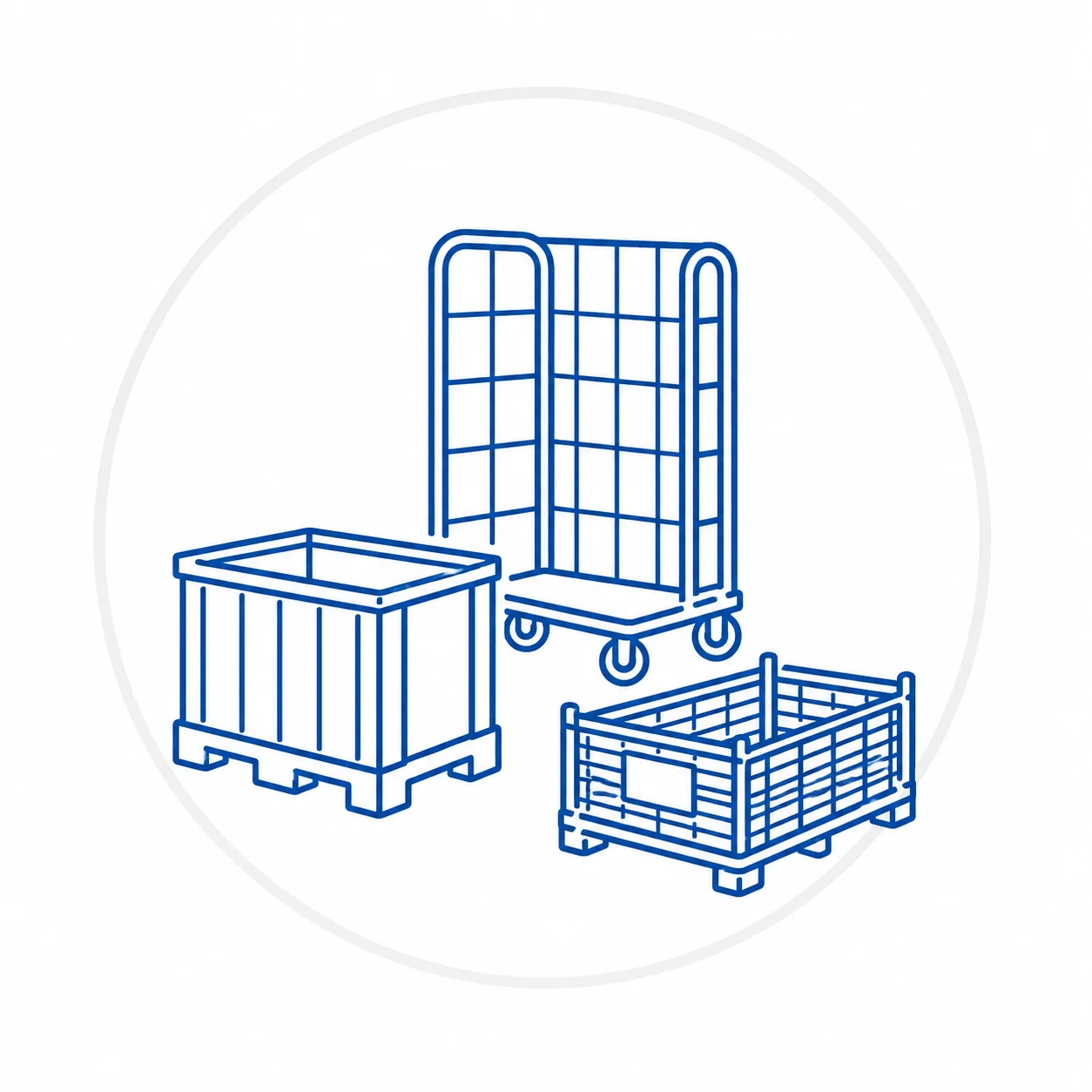
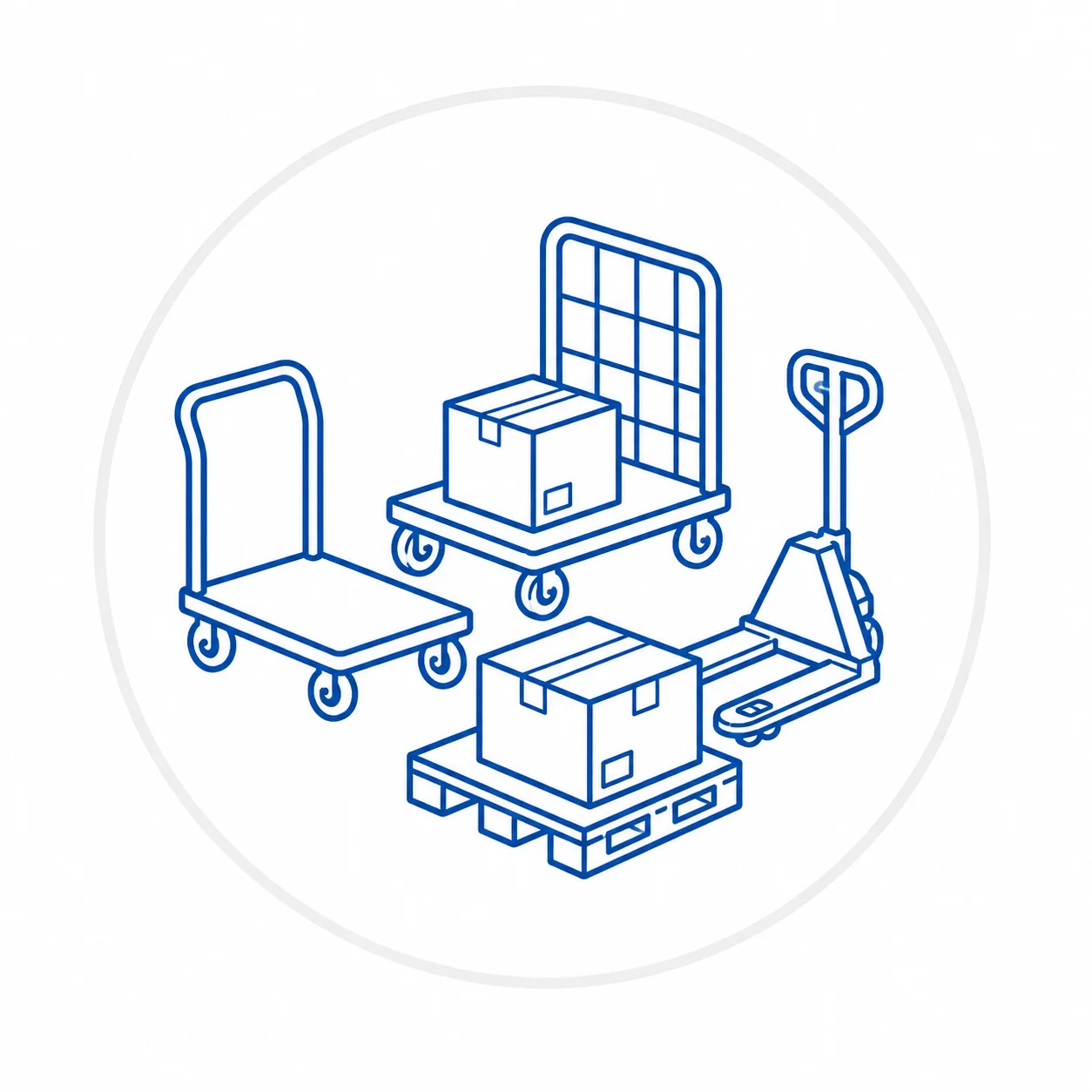
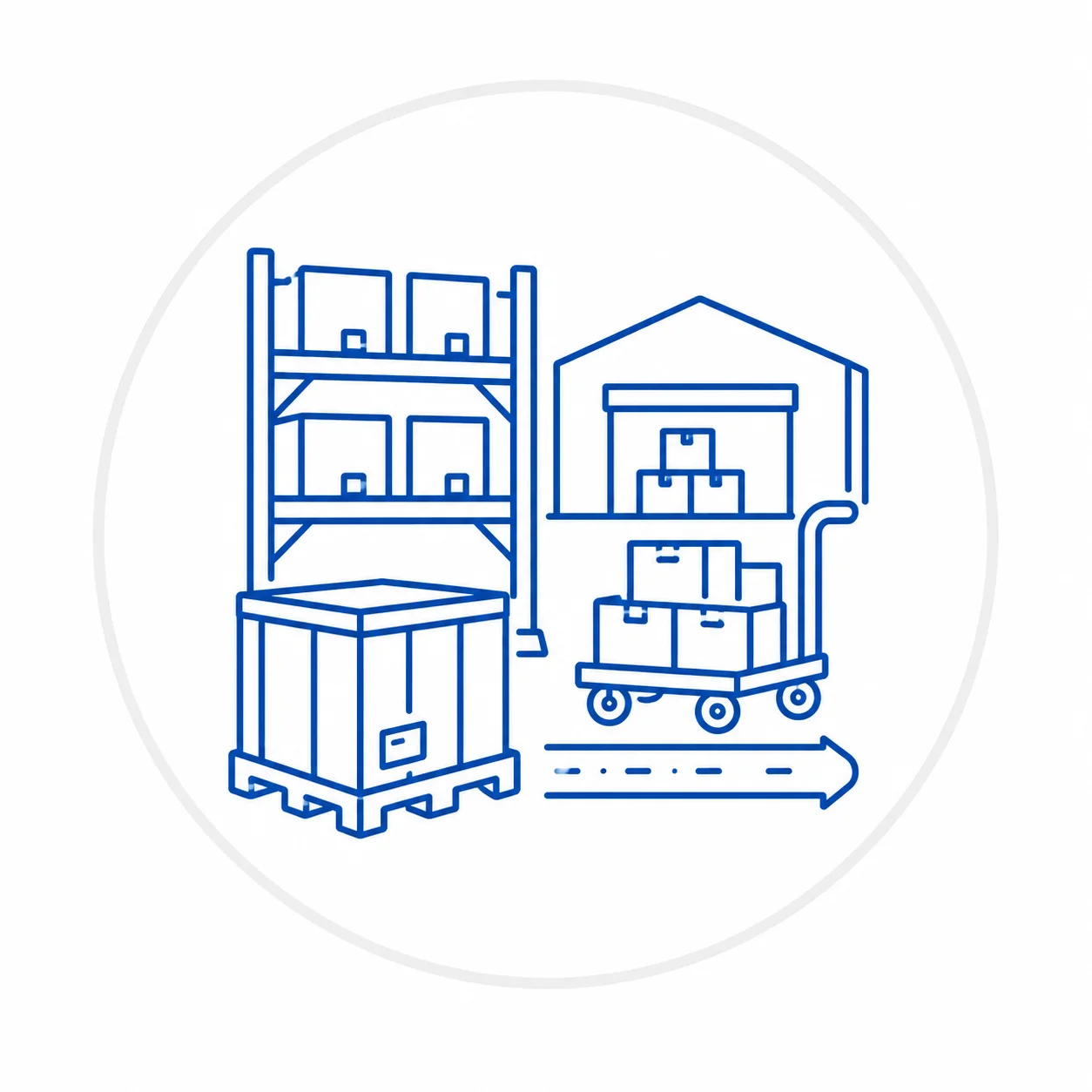
Roll Container may seem like just a metal cage on wheels, but in actual logistics operations, it connects multiple stages, including goods storage, order picking, internal handling, vehicle distribution, and store restocking.
If you’re looking for logistics equipment that makes it easy to move goods while reducing repetitive loading and unloading, understanding the structure, types, and applicable scenarios of roll containers will help you make a more informed purchasing decision.
What Is a Roll Container?
A roll container is a mobile logistics container equipped with casters and a cargo-carrying platform. It typically consists of a metal frame, a base plate, and side panels on two or more sides, and is used for warehousing, order picking, short-distance transport, and logistics distribution.
Unlike ordinary storage bins, it does not require manual lifting of the entire container every time it is moved. Provided that floor conditions and load capacity permit, staff can simply push the roll container to transport batches of goods to designated locations.
Most roll containers for industrial and commercial use are constructed from steel tubing or metal mesh. Depending on requirements, they can be designed with two-sided, three-sided, or fully enclosed sides, and can also be equipped with foldable bases, dividers, locks, or other accessories.
In different countries and industries, you may also encounter the following terms:
- Roll Container: Commonly used in logistics and distribution, warehousing, and the European market.
- Roll Cage: Emphasizes the metal mesh structure; more common in the UK retail and distribution sectors.
- Roll Cage Trolley: Emphasizes the equipment’s mobility and transport capabilities.
- Rolltainer: The term used in some markets to refer to wheeled logistics cages.
- Warehouse Roll Cage: Typically refers to logistics cages used within warehouses or during the distribution process.
While these terms may refer to similar equipment in many contexts, this does not mean that all products have exactly the same structure, rated load capacity, or intended use.
It is important to note that a “Roll Container” is not a shipping container, nor is it the same as a “Roll-Off Container” used for transporting large-scale waste. When purchasing, it is best to confirm the specific type by reviewing product images, structural diagrams, or technical specifications.
How Does a Roll Container Work?
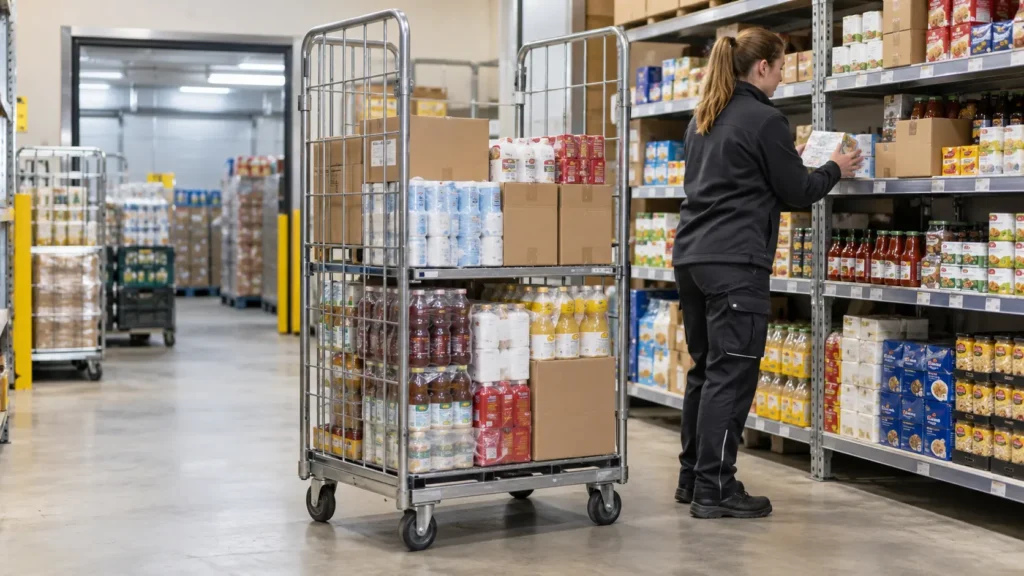
The operating principle of a roll container is straightforward: the cargo is supported by a loading platform, contained within a frame and side rails to prevent movement, and transported horizontally—either manually or with the aid of compatible equipment—via casters.
What really matters is how it integrates into the overall logistics process.
Order Picking and Cargo Consolidation
Suppose you operate a warehouse that distributes goods to multiple supermarkets.
Staff need to pick beverages, packaged foods, and daily necessities from different shelving areas. If they return items to a fixed area after each pick, they would spend a significant amount of time traveling back and forth.
By using logistics carts, staff can consolidate items for the same order or the same store into a single container and then transport them all together to the shipping area.
This may not necessarily reduce the total operation time, but it can eliminate some unnecessary repetitive handling.
Internal Warehouse Transportation
Once goods are loaded into the logistics carts, they can be moved along designated routes from the picking area to the staging area, packing area, or loading zone.
For warehouses that frequently handle cartons and packaged goods, this method helps keep goods consolidated and reduces scattered handling.
Vehicle Delivery and Store Restocking
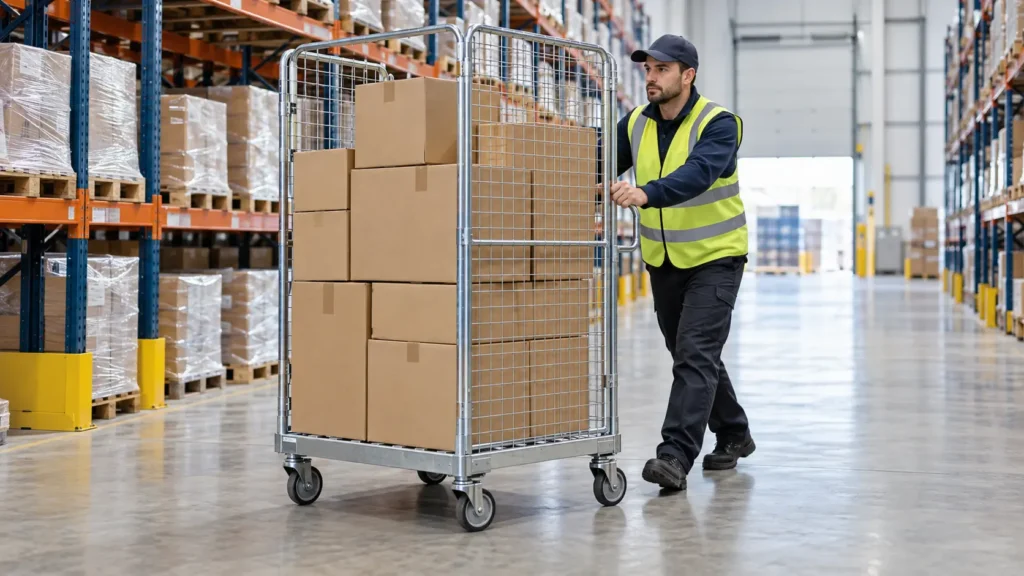
In distribution systems that utilize appropriate loading and unloading equipment, vehicle securing devices, and safe operating procedures, roll cages can serve as reusable cargo transport units.
Once loaded at the distribution center, goods can be moved directly to the backroom or designated restocking area upon arrival at the store.
If merchandise does not need to be repackaged en route, this can reduce some repetitive sorting and loading/unloading work.
Empty Cage Cart Return
After the goods are unloaded, the empty roll cages must be returned to the distribution center.
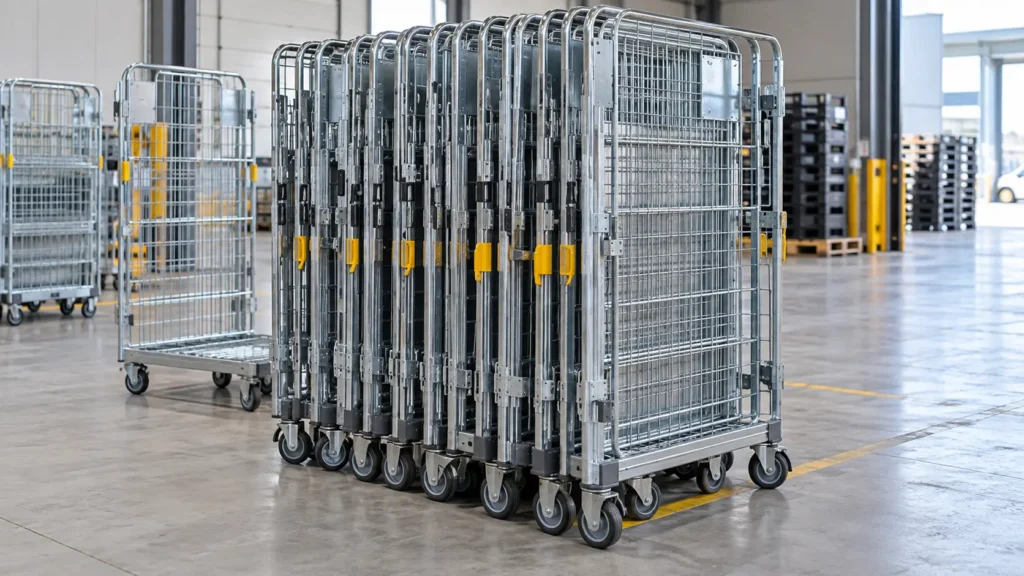
This is where foldable or nestable designs prove their practical value. In certain configurations, they minimize the space occupied by empty carts, making retrieval, storage, and return transport more convenient.
Therefore, when selecting roll containers, it is important to consider not only their performance when fully loaded but also how they will be retrieved and managed after unloading.
What Are the Main Parts of a Roll Container?
Although the appearance varies by model, most industrial logistics roll containers include the following core components.
Steel Frame
The frame serves as the primary load-bearing structure of the entire roll container and is typically manufactured from steel tubing or other steel materials suitable for the design requirements.
The frame design must take into account the weight of the cargo, structural rigidity, welded joints, and the effects of daily impacts and repeated use.
If the equipment needs to frequently pass through doorways, navigate turns, or be loaded into transport vehicles, the frame’s shape also affects operational convenience.
For industrial cage trolleys intended for long-term use, simply increasing the material thickness is not necessarily the best solution. A reasonable structural design, load distribution, and connection methods are equally important.
Metal Mesh Fencing
Metal mesh not only prevents cargo from sliding out from the sides but also allows staff to easily observe the contents inside.
Different types of cargo require different mesh configurations.
For example, when transporting larger cardboard boxes, a more open mesh structure usually meets basic containment needs; when transporting smaller parts, packages, or loose items, attention must be paid to the mesh size, and, if necessary, liners, returnable containers, or other anti-drop measures should be added.
Load-bearing Floor
The base plate directly bears the weight of the cargo and is a critical component that determines the practicality of the cage cart.
Common configurations include:
- Steel load-bearing floor.
- A combination of a plastic base and a steel frame.
- Foldable or flip-up base plates.
- Specialized support platforms designed according to the characteristics of the cargo.
When selecting a platform, consider its load-bearing capacity, localized stress distribution, ease of cleaning, and whether it is likely to interfere with the cargo packaging.
Industrial casters
Casters determine whether a cage cart can move stably and smoothly.
When purchasing, check the wheel diameter, tread material, bearings, mounting structure, and steering mechanism. For situations requiring temporary parking, the braking configuration should also be evaluated.
Common wheel surface materials include nylon, polyurethane, and rubber-based materials. They differ in terms of rolling resistance, noise, wear resistance, floor adaptability, and operating environments.
Quality should not be judged solely based on the color or appearance of the wheels.
Door Panels and Partitions
Four-sided cage carts are typically equipped with openable door panels, allowing staff to create a relatively enclosed structure after loading and unloading goods.
Internal partitions can divide the interior space into different levels.
For example, if you need to transport both lightweight packages that are easily crushed and heavier goods at the same time, a reasonable configuration of partitions can reduce the risk of the cargo crushing each other.
However, each partition should have a clearly defined load capacity; the vehicle’s total rated load capacity should not be equated with the load-bearing capacity of a single partition.
What Are the Different Types of Roll Containers?
Roll containers are not a single product. Different numbers of side panels, opening mechanisms, and storage configurations are suitable for different logistics tasks.
| Types | Key Features | Suitable Scenarios |
| 2-Sided Roll Container | Side panels on both sides; open loading/unloading areas | Retail restocking, frequent picking |
| 3-Sided Roll Container | Enclosed on three sides, open at the front | Warehousing, order picking, and product distribution |
| 4-Sided Roll Container | Enclosed on all four sides, typically equipped with doors | Parcel delivery, retail transportation |
| Nestable Roll Container | Can be nested for storage when empty | Retail chains, circular distribution |
| Foldable Roll Container | Parts of the frame, base, or dividers can be folded | Storage when empty, return transport |
| Heavy-Duty Roll Container | Designed for higher loads or harsh operating conditions | Industrial materials and heavy-duty cargo handling |
These categories are not mutually exclusive. For example, a double-sided roll container may also be stackable.
Double-Sided Roll Container
Double-sided roll containers typically feature support frames on both the left and right sides, leaving the front and rear relatively open for loading and unloading.
Their advantage lies in the ease of loading and unloading goods, making them particularly suitable for high-frequency store restocking.
If your merchandise is already packed in stable returnable containers or standard cardboard boxes and requires frequent, rapid loading and unloading, the two-sided design is worth considering.
However, the open design provides limited lateral containment for goods, so stacking methods and additional securing requirements must be evaluated during use.
TITAN’s 2-Sided Nestable Roll Cage features side rails on both sides and a flip-up base, allowing it to be nested for storage when empty. It is suitable for retail distribution and warehouse logistics.
Three-Sided Roll Container
Three-sided roll containers feature side and rear rails, while the front remains open.
Compared to the two-sided design, it provides additional rear containment while maintaining a relatively convenient access通道 for retrieving goods.
This design is suitable for order picking, internal warehouse handling, supermarket restocking, and daily operations at distribution centers.
For example, staff can quickly load cartons through the open side, with the rear guardrail providing some support for the cargo.
If you’re looking to strike a balance between loading/unloading efficiency and containment capabilities, check out TITAN’s 3-Sided Roll Container.
This model features a steel frame, mesh fencing, and foldable center dividers, allowing the internal space to be adjusted according to actual loading needs.
Four-Sided Roll Container
Four-sided roll containers typically offer a more complete cargo containment structure, making them suitable for scenarios where cargo movement needs to be restricted.
Common applications include express parcels, retail distribution, merchandise turnover, and other logistics operations requiring centralized cargo management.
However, four-sided fencing does not guarantee that the equipment can be safely transported by vehicle without additional securing measures. Door locks, cargo restraints, and vehicle securing still require separate evaluation.
TITAN offers the 4-Sided Parcel Roll Container, designed for parcel sorting, warehousing, and distribution applications.
If your primary task is transporting express parcels of varying sizes, we recommend focusing on the door opening mechanism, mesh size, casters, and effective internal loading space.

Foldable vs. Nestable Roll Containers
These two designs are often discussed together, but they are not exactly the same.
Foldable: Refers to a structure where certain parts can be folded or retracted. For example, a center divider can be flipped up, the base can be raised, or the side frames can be folded in.
Nestable: Refers to the ability of multiple empty roll containers to nest inside one another, thereby reducing the overall footprint when stored together.
If you need to collect a large number of empty roll containers daily, you should not rely solely on the external dimensions of a single roll container; instead, you should further verify:
- The actual dimensions after the empty cage has been folded or collapsed.
- The total length when multiple cages are nested together.
- The steps required for folding and unfolding.
- The durability of the folding mechanism.
- The locking or positioning mechanisms when the cart is unfolded and in use.
These factors directly impact the efficiency of empty container management.
For store deliveries and warehouse operations, you can also review TITAN’s Foldable Roll Container product configurations.
Where Are Roll Containers Used?
Supermarkets and Retail
The retail industry requires frequent transport of goods from distribution centers to stores, and then from the backroom to the shelves.
Roll containers can consolidate the transportation of goods within a single store and reduce some intermediate handling steps through the use of mobile containers.
For retail businesses using a circular distribution model, nestable roll containers can also help manage empty return trips.
Warehouses and Distribution Centers
In Warehouse Roll Cage applications, goods can be centrally managed by order, destination, delivery batch, or product category.
Compared to placing loose goods directly on the floor, using specialized handling equipment makes it easier to plan temporary storage and turnover processes.
However, if operations primarily involve bulk, full-pallet shipments, pallets and corresponding forklift systems may be more suitable.
E-commerce and Express Logistics
E-commerce warehouses often handle large quantities of packaged goods of varying sizes.
Roll cages are suitable for moving batches of packages between the picking, sorting, verification, and shipping areas.
For operations that require passing through multiple distribution nodes, it is recommended to select a mesh structure suitable for the size of the goods and to check the doors, latches, and vehicle securing methods.
Food and Beverage Distribution
Beverage cases, packaged food, and other boxed goods often require frequent handling during warehousing and distribution.
A well-designed cage cart can help consolidate the transport of these goods.
If the equipment is used in humid environments, cold storage, or areas requiring frequent cleaning, special attention should be paid to the casters’ bearings, surface treatment, corrosion resistance, and cleaning requirements.
It should be noted that equipment used for packaged food logistics is not automatically considered food-grade equipment capable of direct contact with food.
Laundry and Hotel Linen Logistics
Commercial laundries, hotels, and textile service companies need to transport sheets, towels, and other linens.
For these scenarios, logistics containers suitable for loading, cleaning, and sorting linens can be selected.
If it is necessary to distinguish between clean and soiled items, clear sorting and management measures should be established in accordance with actual operational workflows, rather than relying solely on the structure of the cage carts.
In-Plant Logistics
Manufacturing companies can use logistics carts to transport packaged parts, production supplies, and other items suitable for manual transport.
If the goods have unusual dimensions, uneven weight distribution, or require positioning and securing, custom base plates, partition structures, or specialized fixtures may be necessary.
For large, irregularly shaped industrial components, fixed return racks, specialized transport racks, or stillages may be more suitable than standard roll containers.
What Are the Benefits of Using Roll Containers?
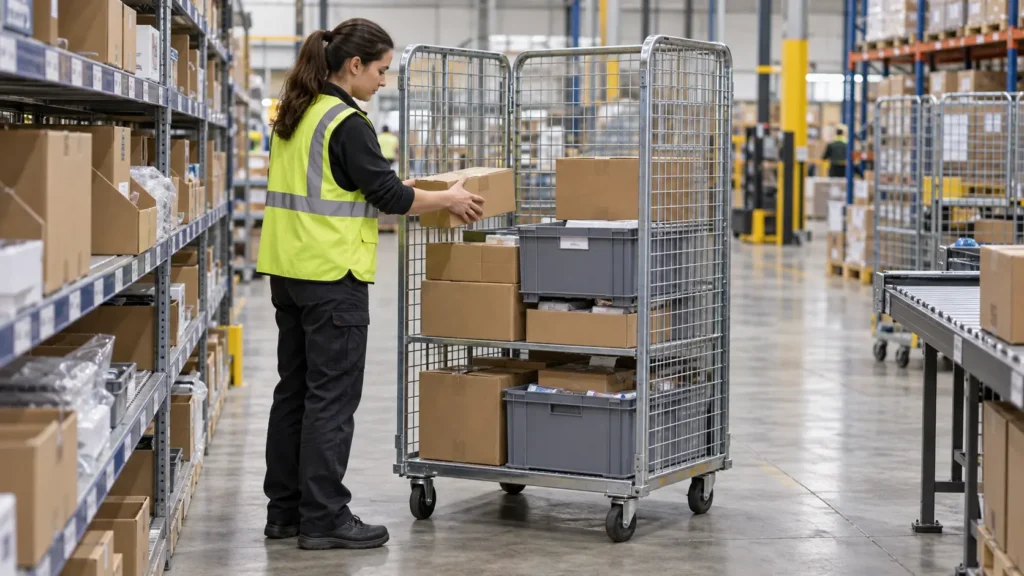
Reduction of Repetitive Handling
When a batch of goods can be loaded into a single movable container and transported directly to the next stage of the process, there is no need to rehandle items one by one at each stage.
This advantage is particularly relevant for businesses with fixed distribution processes between warehouses and retail locations.
However, the effectiveness may be limited if goods require multiple order picking and repackaging operations, or if the handling equipment used at different stages is incompatible.
Improved Goods Organization Efficiency
Roll cages allow goods from different orders or destinations to be stored separately, making identification, sorting, and dispatch easier on-site.
For warehouses handling large volumes of packaged goods, they can also serve as temporary mobile storage units.
Providing Some Protection for Goods
The steel mesh and frame restrict the movement of goods in certain directions, reducing the risk of items falling due to improper stacking.
However, cage trolleys are not devices that automatically guarantee cargo safety. Small items, goods with a high center of gravity, and irregularly shaped items still require appropriate packaging and securing measures.
Improved Space Utilization in Logistics Cycles
If a company transports and recovers a large number of empty cage trolleys daily, a folding or nestable design can reduce the space required for empty storage and return transport.
The actual savings depend on the cage’s folding mechanism, fleet size, vehicle layout, and return process; they cannot be generalized using a single percentage.
Supporting Long-Term Reuse
Unlike single-use transport packaging, durable metal logistics cages can serve as reusable logistics assets.
Through regular inspections, maintenance, and replacement of worn parts, companies can extend the service life of their equipment.
What really needs to be evaluated is the cost over the entire lifecycle, not just the purchase price.
How to Choose the Right Roll Container?
When selecting a roll container, it is recommended to start by considering four factors—cargo, site conditions, operating methods, and service life—before determining specific structural parameters.
Determine Load Capacity Based on the Cargo
First, determine the actual weight of the cargo each roll container will transport.
You need to confirm not only the total mass of the cargo but also whether the weight is concentrated, whether the cargo is prone to shifting, and whether there is significant load imbalance during loading.
For models with dividers, you should verify both the roll container’s total rated load capacity and the allowable load per divider level.
For example, if a roll container needs to transport 40 boxes of goods, each weighing 10 kg, the total mass of the cargo is 400 kg.
However, this does not mean that a cage truck with a rated load capacity of 400 kg is necessarily suitable for this application. You must also consider the definition of rated load capacity, load distribution, ground conditions, method of movement, and safety requirements.
Manufacturers should confirm load-carrying capacity based on the relevant operating conditions, rather than judging solely by the weight of the cargo.
Determine the actual dimensions, rather than relying solely on the product’s external appearance
Many procurement issues aren’t caused by the cart being unable to hold the goods, but rather by its inability to navigate the actual work aisles smoothly.
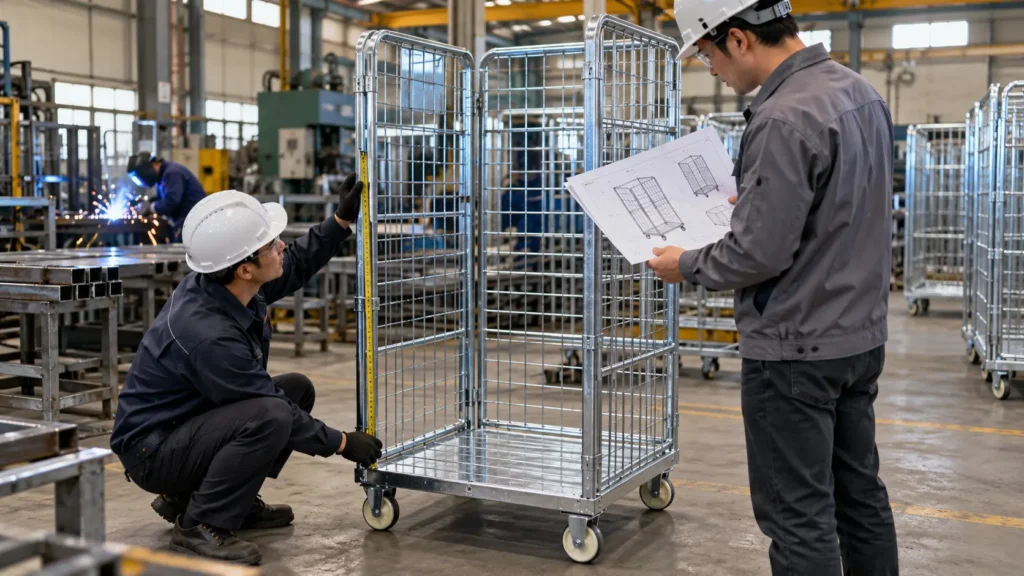
You need to measure:
- The effective clear width of warehouse doors and aisles.
- The available space in elevators, vehicles, and loading docks.
- The turning areas the cage cart needs to navigate.
- The loading dimensions of the goods inside.
- Whether the cart needs to pass through a truck tailgate or ramp.
It is important to note that the external dimensions of a product are not the same as its internal effective loading dimensions.
Casters, frames, handles, and door panels may all affect the available space for the equipment in the actual work environment.
Select the enclosure structure based on loading and unloading frequency
If staff need to repeatedly remove and replace goods, prioritize evaluating open-structure designs.
If goods are prone to sliding out from the sides or are transported between multiple distribution points, stricter requirements for containment and securing methods should be implemented.
For goods that need to be sorted and stored, consider adding intermediate dividers.
More enclosures do not necessarily translate to higher actual work efficiency. You need to strike a balance between ease of retrieval, cargo containment, and operational safety.
Choose Casters Suitable for the Floor
Casters may seem like a minor component, but they affect pushing resistance, operational comfort, and long-term maintenance costs.
If the warehouse floor is level and there is frequent transport, you should focus on comparing the casters’ rolling resistance and wear resistance.
If there are floor joints, small obstacles, or rough surfaces, you’ll need to further evaluate the wheel diameter and tread material.
The UK Health and Safety Executive (HSE) notes in its safety guidelines for roll-cage trolleys that caster design affects the force required for manual pushing, illustrating the impact of crossing small steps using the difference between 100 mm and 125 mm wheel diameters.
However, this does not mean that 125 mm casters are suitable for all warehouses. The correct choice still depends on the floor surface, load, operating methods, and space constraints.
Selecting the Appropriate Surface Finish
Standard steel cage trolleys can be finished with galvanization, other appropriate anti-corrosion treatments, or powder coating depending on usage requirements.
If the equipment is exposed to damp conditions or frequent cleaning over the long term, attention should be paid to corrosion resistance, coating durability, and structural areas prone to water accumulation.
If the equipment is primarily used in dry indoor warehouses, options can be selected based on the actual environment, service life requirements, and budget.
Different surface treatments should not be compared based solely on appearance; specific manufacturing processes and acceptance requirements must also be verified.
Consider Empty Cart Management and Long-Term Maintenance
Purchasing 20 cage trolleys and managing 2,000 cage trolleys are entirely different operational challenges.
For companies with high-volume, repetitive use, empty cart storage, repairs to damaged parts, caster replacement, serial number tracking, and return transportation can all generate ongoing costs.
Therefore, before selecting a product, you should clarify the following:
Do the cage trolleys need to be nestable? Are the casters easy to replace? Are the dividers easy to repair? Is daily inspection convenient?
These questions are often more meaningful than simply comparing the amount of steel used.
What Should You Ask Before Buying Roll Containers?
When requesting a quote from a supplier, simply stating, “I need 500 roll containers,” is usually not enough.
This is because even with the same quantity, differences in structure, materials, load capacity, and caster configurations can all affect costs and delivery arrangements.
To obtain a more accurate quote, we recommend preparing a list of basic procurement requirements:
| Procurement Information | Information to Include |
| Product Type | Two-sided, three-sided, four-sided, or other models |
| Dimensions | External Dimensions and Effective Loading Space |
| Load Capacity | Rated load capacity of the entire vehicle and special load conditions |
| Material | Steel and Other Material Requirements |
| Surface Treatment | Galvanized, painted, or as specified |
| Casters | Wheel diameter, wheel surface material, steering, and braking requirements |
| Accessories | Partition panels, door panels, latches, etc. |
| Operating Conditions | Indoor, outdoor, cold storage, ramps, and other environments |
| Order Quantity | Initial order quantity and estimated annual purchase volume |
| Drawings | 2D drawings, 3D models, or reference images |
| Delivery | Destination and Desired Delivery Arrangements |
If you do not yet have complete drawings, please at least specify the dimensions, weight, handling procedures, and estimated purchase quantity of the goods.
This information allows the manufacturer to determine whether to use a standard model or to design a custom structure.
For long-term procurement projects, you should also discuss product acceptance criteria, the sample approval process, spare parts support, and consistency between order batches.
Common Mistakes When Buying Roll Containers
Misconception 1: The More Side Panels, the Better
Four-sided railings provide more complete containment of the goods but may also increase the number of steps required for loading and unloading.
If your operations primarily involve high-frequency picking within a warehouse, a three-sided or two-sided design may be more suitable.
The true basis for selection is the characteristics of the goods and the frequency of loading and unloading.
Misconception 2: Comparing Only the Maximum Load Capacity
Two cage trolleys with the same rated load capacity do not necessarily have the same actual performance.
Frame structure, castor configuration, base plate support, load distribution, and testing conditions all affect the equipment’s suitability.
When purchasing, ask the supplier to specify the conditions under which the rated load applies.
Misconception 3: Ignoring the Cost of Returning Empty Carts
For circular distribution projects, the return of empty carts may occupy warehouse and transportation space over the long term.
If there are a large number of empty carts, stackable or foldable designs should be considered as part of the procurement evaluation.
Misconception 4: Focusing Only on Unit Price
Purchasing price is an important factor, but long-term operation also involves maintenance, decommissioning, replacement, and recycling.
If equipment is used frequently on a daily basis, long-term performance and ease of maintenance should be factored into procurement decisions.
Conclusion
Roll containers may seem like simple logistics equipment, but what truly determines their value is more than just a frame and four wheels.
For retail, warehousing, e-commerce, food delivery, and other industries that require frequent handling of packaged goods, the right roll container can help centralize cargo management, reduce repetitive handling, and support daily delivery and reuse.
However, it is not a one-size-fits-all solution for all handling challenges.
If goods require mechanical handling by the pallet, pallets may be more suitable; if the primary cargo consists of large, irregularly shaped industrial parts, specialized transport racks may be necessary. Only by clearly understanding the characteristics of the cargo, operational workflows, and on-site constraints can you determine which type of equipment is most appropriate.
Need Custom Roll Containers for Your Business?
TITAN is a logistics equipment manufacturer based in China that offers roll cages, logistics containers, transport racks, and related custom manufacturing services.
Whether you need standard models, bulk purchases, or the development of new roll cages tailored to specific warehousing and distribution projects, you can discuss your actual needs with the TITAN team.
You can provide dimensions, load capacity requirements, drawings, reference images, or estimated purchase quantities to facilitate a technical evaluation and receive a quote.
Contact TITAN — Request a Custom Roll Container Quote
Adapt logistics equipment to your workflow—don’t let your workflow adapt to the equipment.
Frequently Asked Questions About Roll Containers
What is the difference between a roll container and a roll cage?
In the logistics industry, “roll container” and “roll cage” typically refer to similar types of mobile cage equipment; both generally feature a load-bearing base, casters, and a surrounding structure. A “roll cage” emphasizes the appearance of its metal fencing, while “roll container” is a more general term for logistics containers. When purchasing, you should base your decision on the specific structure, dimensions, and technical specifications; you cannot determine whether products are the same based solely on their names.
What are the main types of roll containers?
Common types include two-sided, three-sided, four-sided, foldable, nestable, and heavy-duty logistics roll cages. Two-sided models are generally more convenient for loading and unloading; three-sided models balance open handling with cargo containment; four-sided models are suitable for scenarios requiring more complete enclosure; and foldable or nestable designs are primarily used to improve storage and return efficiency when empty.
What are roll containers used for?
Roll containers are primarily used for warehouse storage and handling, order picking, supermarket restocking, retail distribution, e-commerce package sorting, and internal factory logistics. They allow multiple items to be consolidated onto a movable loading device, reducing some repetitive handling. Their practical applicability depends on the weight of the goods, packaging methods, facility layout, and operational processes.
How much weight can a roll container hold?
There is no uniform load capacity value applicable to all roll container models. The permissible load depends on the frame, base plate, casters, dividers, structural design, and operating conditions. When purchasing, verify the container’s total rated load, single-layer load capacity, and corresponding test conditions. Do not estimate the container’s total load capacity by simply adding up the nominal load ratings of the four individual casters.
What is the standard size of a roll container?
There is no globally standardized size for roll containers. Different retail, warehousing, and distribution systems use varying heights, widths, and depths. When selecting a size, you should consider the packaging of the goods, warehouse aisles, doorways, elevators, delivery vehicles, and the available internal loading space. If standard sizes do not fit your site, you can also evaluate custom solutions.
What materials are roll containers made from?
Common roll containers feature a steel frame and welded metal mesh, paired with a steel or plastic load-bearing base. Some models undergo surface treatments such as galvanizing or powder coating. Casters can be selected with different tread patterns and bearing configurations based on operating conditions. Material selection should consider the operating environment, load capacity, cleaning requirements, corrosion resistance, and maintenance costs.
What is the difference between 2-sided, 3-sided, and 4-sided roll containers?
The main differences lie in the number of sides and the method of loading and unloading goods. The 2-sided design is more open and suitable for frequent access to goods; the 3-sided design adds a rear enclosure while retaining open loading and unloading sides; the 4-sided design typically provides more complete containment of the goods. The specific choice should be based on cargo stability, loading and unloading frequency, and distribution requirements.
What is the difference between foldable and nestable roll containers?
A “foldable roll container” refers to a roll container with parts that can be folded or collapsed; a “nestable roll container” emphasizes that multiple empty roll containers can be nested inside one another for storage. Some products offer both features, but not all foldable models are nestable. When purchasing in bulk, be sure to confirm the actual storage dimensions and operating procedures.
Is a roll container better than a pallet for warehouse use?
There is no one-size-fits-all solution for all warehouses. Roll containers are better suited for packaged goods that require frequent manual pushing, picking, and distribution; pallets are generally better suited for storing full-pallet loads and for use with forklifts or pallet handling equipment. The choice should be based on the quantity and weight of the goods, equipment configuration, handling distance, and loading/unloading frequency.
Can roll containers be customized for specific warehouse requirements?
Yes. Custom roll containers can typically be tailored to project requirements in terms of dimensions, railing structure, load capacity, casters, dividers, doors, and surface finishes. TITAN offers OEM/ODM and custom manufacturing services for roll containers. Buyers can provide product drawings, reference images, load requirements, usage scenarios, and estimated quantities to facilitate technical evaluation and pricing quotes.